App.js Conf ‘26
Learn more about ‘26 edition.

App.js Conf ‘26 Talks
How to Build the Fastest Apps: Break the Rules
Many standard React best practices are actually destroying your app's performance. In this talk, we'll break those rules and rethink core mental models around state, data, sync, rendering, and architecture. We'll analyze the specific optimizations that make Legend List and Legend State so fast, and show exactly how to apply them to dramatically improve the speed and responsiveness of your apps.
Is AI making React Native obsolete?
AI is making app development faster, but it is also changing the tradeoffs. React Native used to win on speed and shared code. With AI now able to write and convert code across platforms, that advantage is less obvious. In this talk, we test this by building the same app in React Native and in Swift, then using agents to convert it to Kotlin. The goal is to see where React Native still works well, where it struggles, and what this means for teams choosing how to build their apps.
Re-architecting the ElevenAgents SDK for React Native
Lack of performance from over-rendering, low maintainability, and poorly tested: ElevenLabs' React Native SDK had issues. Kraen will run through the architecture they eventually settled on: a universal imperative SDK with a universal hooks-based React SDK built on top.



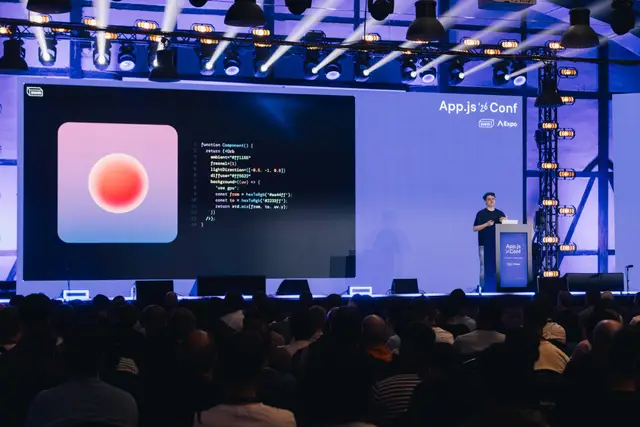
Write TypeGPU, Use Anywhere: Composable WebGPU Shaders for React Native and Beyond
There was a time before bundlers when JavaScript files interacted with each other through global state and had constants injected by backend frameworks into script tags. This is still true in the world of shader programming. Many devs choose to roll their own shader systems, concatenating strings and injecting constants, but as complexity grows, so does the need for more sophisticated bundler features. TypeGPU takes advantage of existing patterns and provides a system that works everywhere JavaScript and WebGPU run. Dead-code elimination, name collision avoidance, compile-time specialization and generics are just a handful of features you get for free. Write your shaders once, and use them with your framework of choice: Three.js, React Native Skia, or your own custom engine. We provide the primitives so you can focus on building your apps your way
Shipping Partiful on Autopilot
Partiful ships its Expo app to millions of users once a week, every week. I'll walk you through our pipeline and share the history, the tips, and the tricks that got us from 1.0 to 3.4.10 and beyond.
Illusion of Portals in React Native
Portals feel like a solved problem in React—but in React Native, things aren’t quite what they seem. Many developers rely on “portal” solutions without questioning what’s really happening under the hood. But subtle inconsistencies, edge cases, and limitations hint at a deeper truth: something fundamental is missing. In this talk, we’ll challenge common assumptions and take a closer look at what’s really going on beneath the abstraction. Along the way, you’ll discover a different way of thinking about UI structure in React Native—one that unlocks patterns most developers don’t even realize are possible.
Challenges in Building React Native Applications with On-Device AI
Models designed to run on edge devices are more popular than ever, and running them on phones with React Native seems straightforward, but it introduces a unique set of challenges you won't see coming. This talk draws on a year and a half of building react-native-executorch and shipping real applications with on-device inference. We'll walk through the problems that surface only once you actually try: app sizes exploding, models crashing on mid-range devices, batteries draining during continuous inference, and the UX challenges of long model loads. We'll cover both LLM and computer vision use cases, from on-device chat to real-time object detection, and the very different constraints each brings to mobile. You'll leave knowing which mobile AI use cases are production-ready today and which ones still need more time.
Screens & Routers — The Foundation of Navigation in React Native Apps
Navigation is at the core of nearly every mobile application. When building React Native apps, you likely connect your screens using React Navigation or Expo Router. But have you ever wondered what happens under the hood? How does your app actually switch screens when a user interacts with it? In this talk, we’ll explore how React Native Screens and Expo Router work together to deliver native functionality through a simple API. Stick with us until the end for an exciting announcement.
Liquid User Interfaces for the Next Generation of AI Applications
Chat is not the only way AI can present itself to users. This talk shows how to build AI-native interfaces beyond chat by shipping a design system, a renderer, and a server-driven protocol instead of hardcoded screens. AI becomes the composition layer, assembling safe, predefined components into liquid interfaces that adapt in real time. Attendees will leave with a concrete mental model for the pattern, an incremental architecture, and a practical sense of how Expo, design systems, and server-driven UI fit together.